
- Excavation
- Roads and Ponds
Building a Farm Pond and Access Road on Oklahoma Acreage
A pond and a road are two different excavation jobs that usually get planned together. Here is what actually goes into each one.

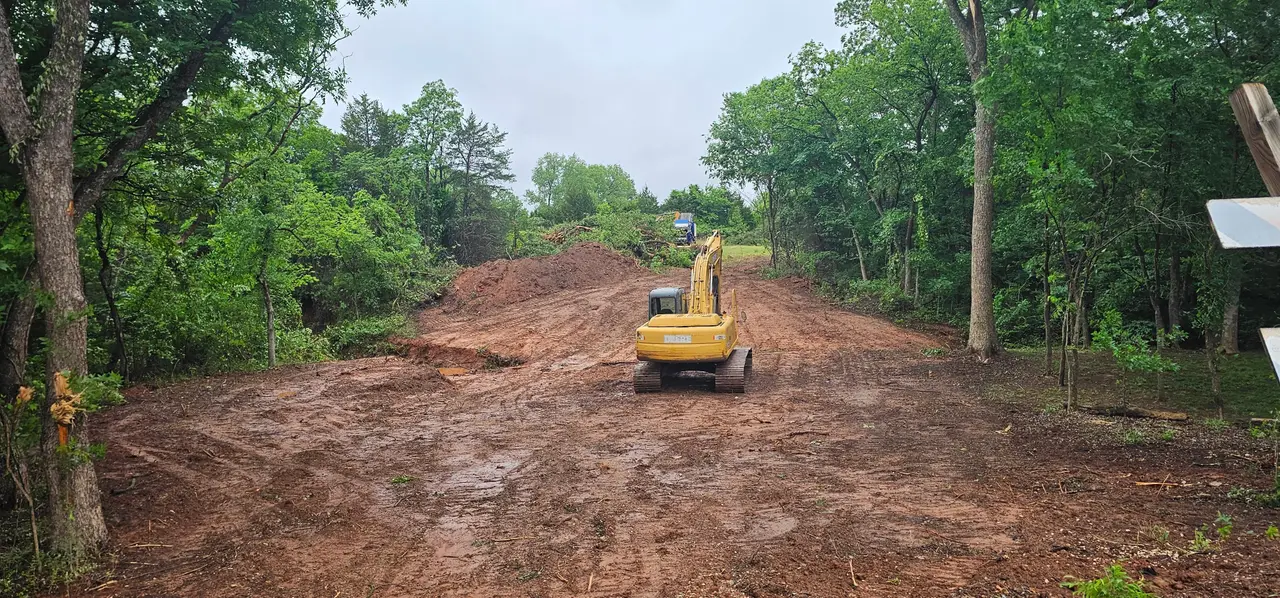
Building a farm pond means excavating a basin sized to your watershed, compacting an embankment if the site needs a dam, and sizing a spillway to handle real runoff, not just digging a hole and waiting for rain. Cutting an access road means clearing a path and then building it to actually carry equipment and vehicles through wet ground, not just opening a strip of dirt. Both are common requests on the same property, usually because the road is what gets machines back to where the pond needs to go.
Here is what each one actually involves, because both get oversimplified constantly and both fail in predictable ways when they are.
What a pond actually is: a watershed with a basin in it
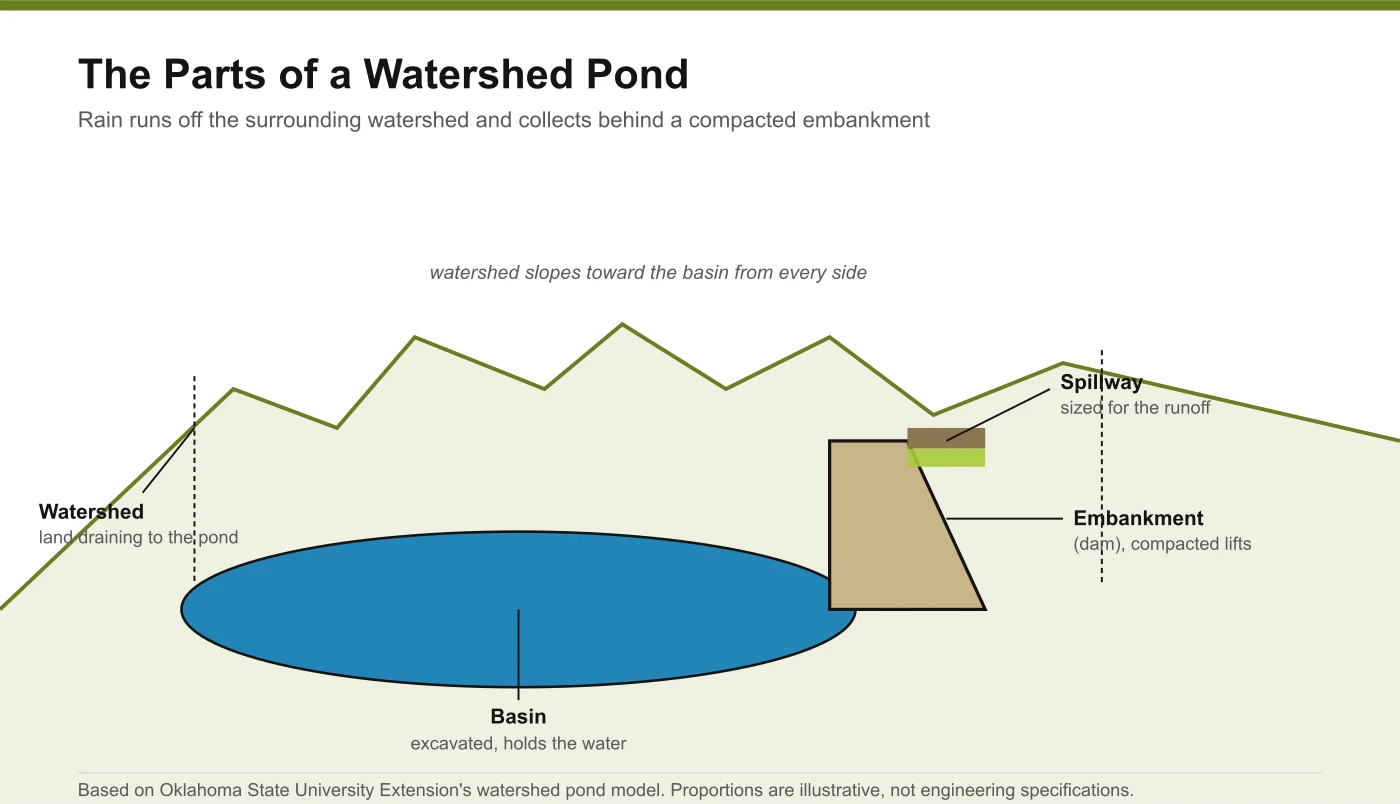
Most Oklahoma farm ponds are watershed ponds. Rain runs off the surrounding land and collects in a basin formed by an embankment, or dam, built across a low point. The pond depends entirely on that watershed, the land area draining into it, for enough water to stay full. A pond dug in the wrong spot, with too small a drainage area behind it, will sit low or dry no matter how well it was built.
The basin gets excavated, and on ponds that need a dam, contractors typically remove soil from the basin with a scraper and use that same material to build the embankment in thin, compacted lifts, commonly around six inches at a time, with a sheepsfoot roller or dozer tracks doing the compaction. That lift-and-compact process is what keeps an embankment from settling or failing later. Skipping it to save time is the single most common reason a homemade dam does not hold.
The spillway is the part that decides if the dam survives
A dam without a spillway sized for real runoff is a dam waiting on one bad storm. The spillway has to move the maximum water that watershed will realistically send it during a heavy rain event, and Oklahoma’s rain does not come gently. Undersized spillways are why ponds blow out, not bad luck.
This is exactly where an engineer earns the fee on anything beyond a small stock pond. An engineer calculates soil adequacy for the intended use, the runoff the specific watershed will produce, and a spillway sized for that. Oklahoma State University Extension’s own guidance on pond building lays this out plainly: NRCS staff and private engineers bring calculations that earthwork contractors typically do not, and they are also who will be current on what state and federal rules apply, including wetland protections under the Clean Water Act and dam safety requirements. We will tell you honestly when a pond project has crossed from a job we can size and build ourselves into one that needs that engineering step first.
Permits: usually not required, but confirm before you dig
Small agricultural or residential ponds often do not need a state permit in Oklahoma. That is not a guarantee for your specific site. Whether a permit applies depends on your county, on whether the location touches a floodplain, and on whether the disturbed area crosses the one-acre threshold that can trigger Oklahoma Department of Environmental Quality stormwater requirements.
Two things are worth checking before you commit to a pond site. First, pull the FEMA flood map for your parcel, since a pond planned inside a mapped floodplain is a different conversation than one on high ground. Second, call your county to ask what local rules apply, because that answer genuinely varies by county in Oklahoma and we would rather send you to the source than guess.
The road: clearing is the first step, not the whole job
An access road that only got cleared is a strip of dirt, and a strip of dirt turns into standing water and ruts the first time it rains hard, which in central Oklahoma is not a rare event. Building a road that actually holds up takes a few things clearing alone does not give you.
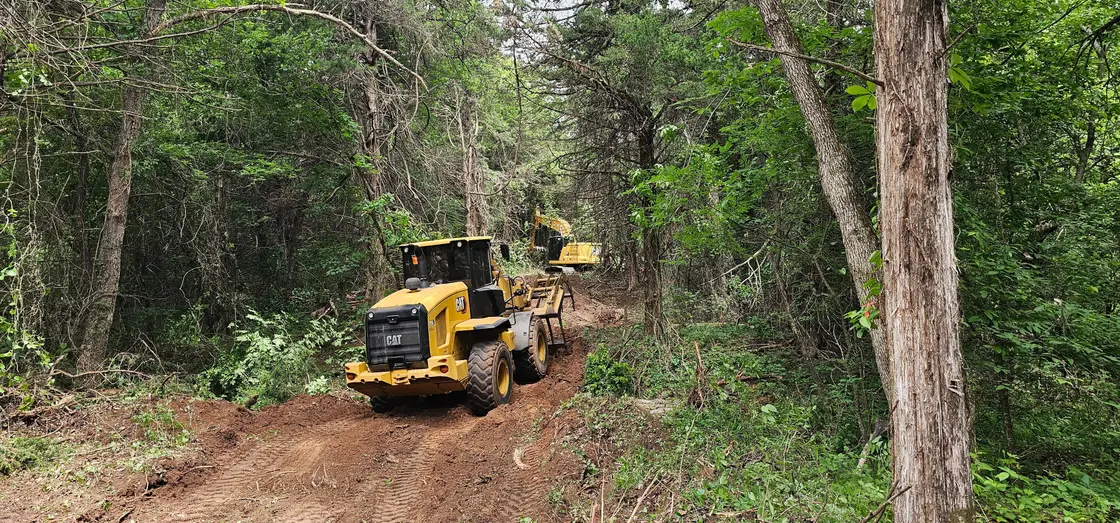
The road needs a real base, not just cleared native soil, and it needs a crown or a consistent slope so water sheds off the travel surface instead of pooling in it. Anywhere the road crosses a draw or a low spot, it needs a culvert or a proper low-water crossing, or that crossing becomes the first place the road fails. We grade every access road we build to actually carry the equipment and vehicle traffic it is meant for, which is a different standard than simply opening a path wide enough to drive through once.
Why these two jobs often go together
If a pond site is hard to reach, the road frequently has to go in first just to get equipment back there. Sequencing them together also means material excavated from the pond basin can sometimes be reused on the road base or the embankment instead of hauled off site and then bought back in as fill, which is a real efficiency when the soil is suitable for both.
Farm ponds and access roads in the Shawnee area and beyond
We build farm ponds and cut and grade access roads across the Oklahoma City metro and about 150 miles around it, including Shawnee and the rest of Pottawatomie County. For the excavation and grading work that supports both, see our excavation and dirt work page and our roads and ponds service page.
Every pond and every road depends entirely on the ground it sits on, which is why we do not price either one off a satellite photo. Estimates are free and done in person, on site. Call (405) 465-2809 or request an estimate.
Sources: OSU Extension, Building a Pond | FEMA Flood Map Service Center