
- Brush Clearing
- Land Clearing
Pasture Reclamation in Mustang, OK: Reclaiming Overgrown Ranch Land
Cedar and brush do not stop on their own. Here is the order the work goes in, how the method gets chosen, and why every year you wait makes the acre cost more.

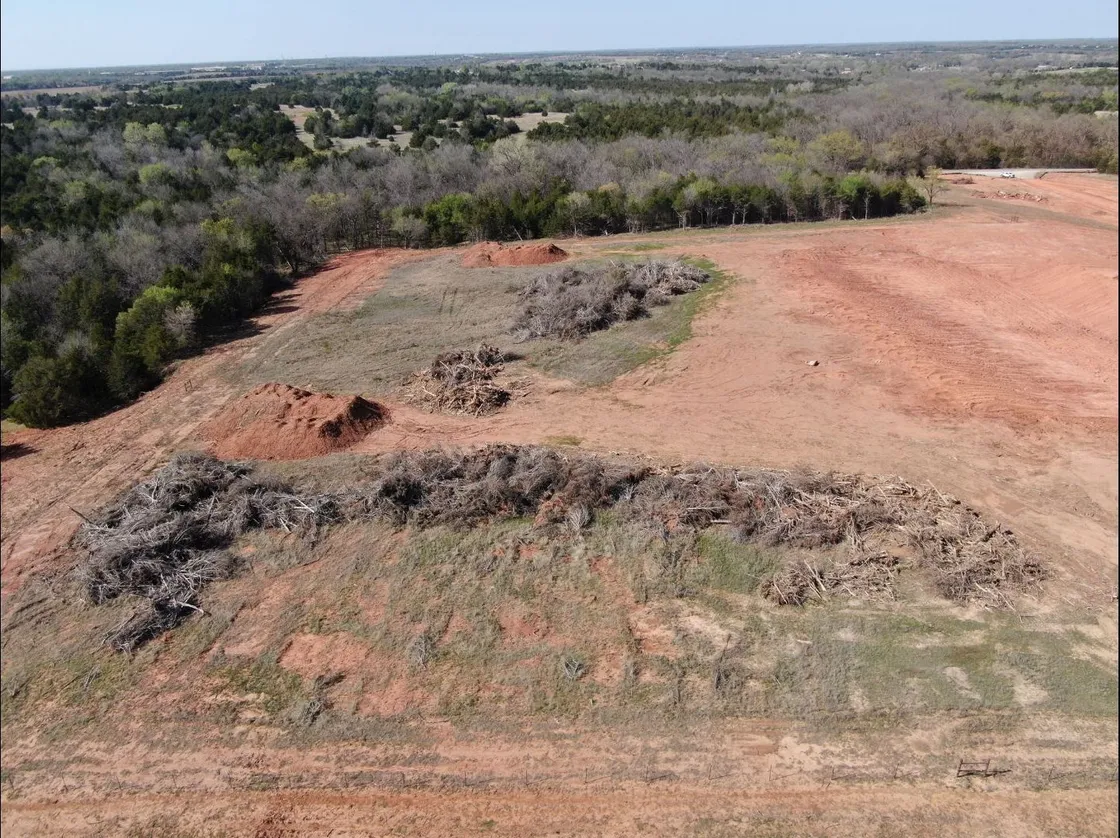
An overgrown pasture comes back in a set order: identify what is standing, decide what the ground has to do when it is finished, take the woody growth off with the machine that matches it, deal with the root balls only where equipment has to run, then plan the follow-up. The expensive mistakes almost always happen in the first two steps, before a single machine ever gets unloaded.
If you own acreage around Mustang and the pasture has gone to cedar and brush, here is the part nobody enjoys hearing: it is not going to thin out on its own, and every season you leave it, the same acre gets more expensive to fix. That is not a sales line. It is the reason Oklahoma State University Extension tells landowners to treat encroachment early, and flatly notes that treating sites with severe infestation is economically impractical. Below is how the work actually gets done, so you can walk your own ground and know roughly what you are looking at before you call anybody.
How do you reclaim an overgrown pasture?
- Walk it and identify what is standing. Eastern redcedar, sumac, greenbriar, persimmon, and volunteer blackjack all take a different machine and a different amount of time. A pasture that looks uniformly grown up from the road is usually three or four different problems.
- Decide what the pasture has to do afterward. Grazing ground and hay ground get finished differently, and that decision changes the price more than the brush does.
- Take the woody growth off. Forestry mulching, an excavator with a grapple, or a dozer, matched to stem size and to how much material can stay on the ground.
- Handle the root balls where they matter. Grubbing is only necessary where implements or vehicles have to cross. Everywhere else, low-cut stumps are fine.
- Plan the follow-up. Clearing is a reset, not a cure. Without a maintenance plan, you are scheduling this same job again in about ten years.
What actually took your pasture
Encroachment does not arrive all at once. It creeps in from the edges: a fence line that stopped getting mowed, a draw that is too rough to run equipment through, a corner behind the pond. Those become the seed source, and from there it moves out into open ground where nothing is competing with it.
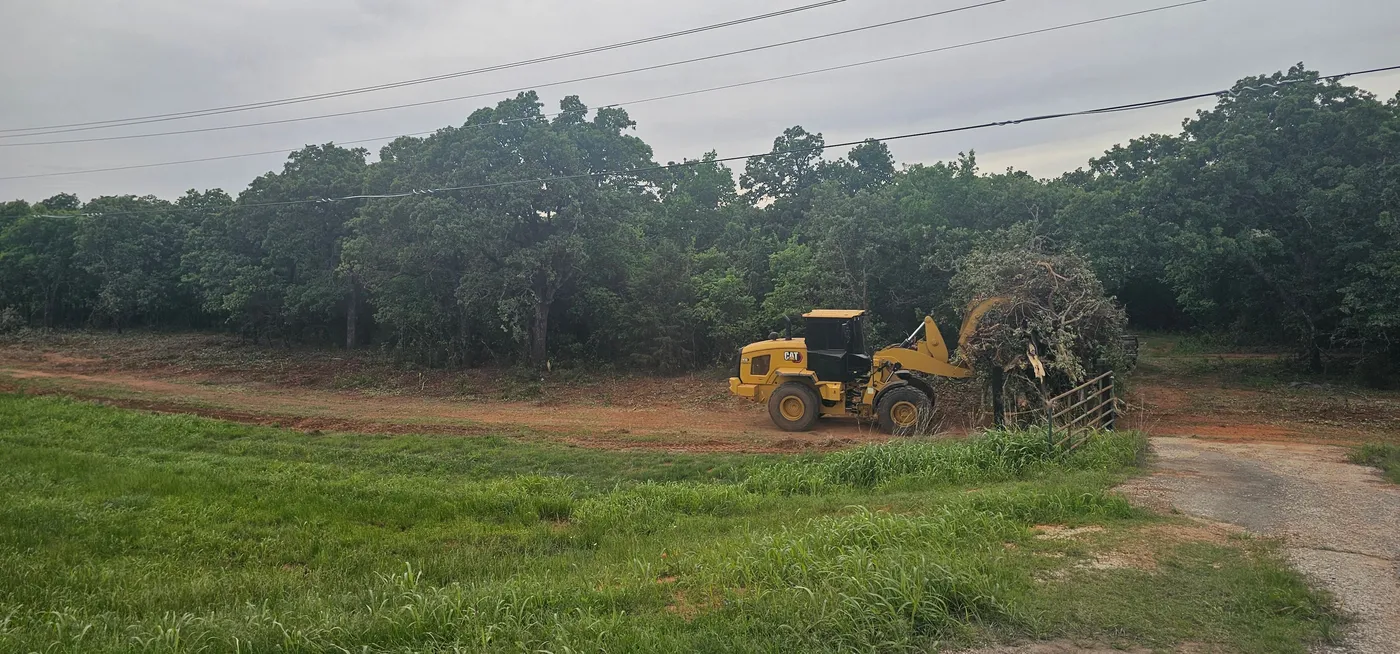
The fence line is almost always where it starts, and it is almost always the part landowners underestimate. A mile of fence that has grown up solid holds enough standing material to reseed the whole pasture, which is why clearing the middle and leaving the perimeter is a short-term fix at best.
Eastern redcedar is the tree that changes the math
Cedar is the one worth understanding on its own, because it does something the other brush does not. It is evergreen, so it competes for water twelve months a year rather than through a growing season, and OSU Extension research on Oklahoma rangelands ties that directly to the water cycle. Their work shows that replacing grass with woody cover raises the share of rainfall that goes back to the atmosphere, and that on semi-arid ground a small increase in that ratio translates into a large percentage drop in streamflow and groundwater recharge. In one western Oklahoma example, on land receiving 26 inches of annual precipitation, a seven percent increase in that ratio amounted to roughly a 60 percent reduction in average annual streamflow.
You will notice that before you notice anything else. Ponds that used to hold through August stop holding. Draws that used to run after a good rain stop running. The grass thins under the canopy first and then keeps thinning outward. By the time the canopies are touching, you are not managing a brush problem anymore, you are managing a water problem.
The details are worth reading straight from the source. OSU Extension publishes fact sheets on how redcedar encroachment affects the water cycle of Oklahoma rangelands and on redcedar control and management practices.
Why waiting is the most expensive decision you will make
Clearing cost does not rise in a straight line with canopy cover. It bends. Scattered trees in open grass are a single pass with one machine. A closed canopy is a different job entirely: the machine slows down, the material volume multiplies, a second machine usually has to come out to handle it, and the ground underneath has been sitting shaded and bare long enough that it needs help too.
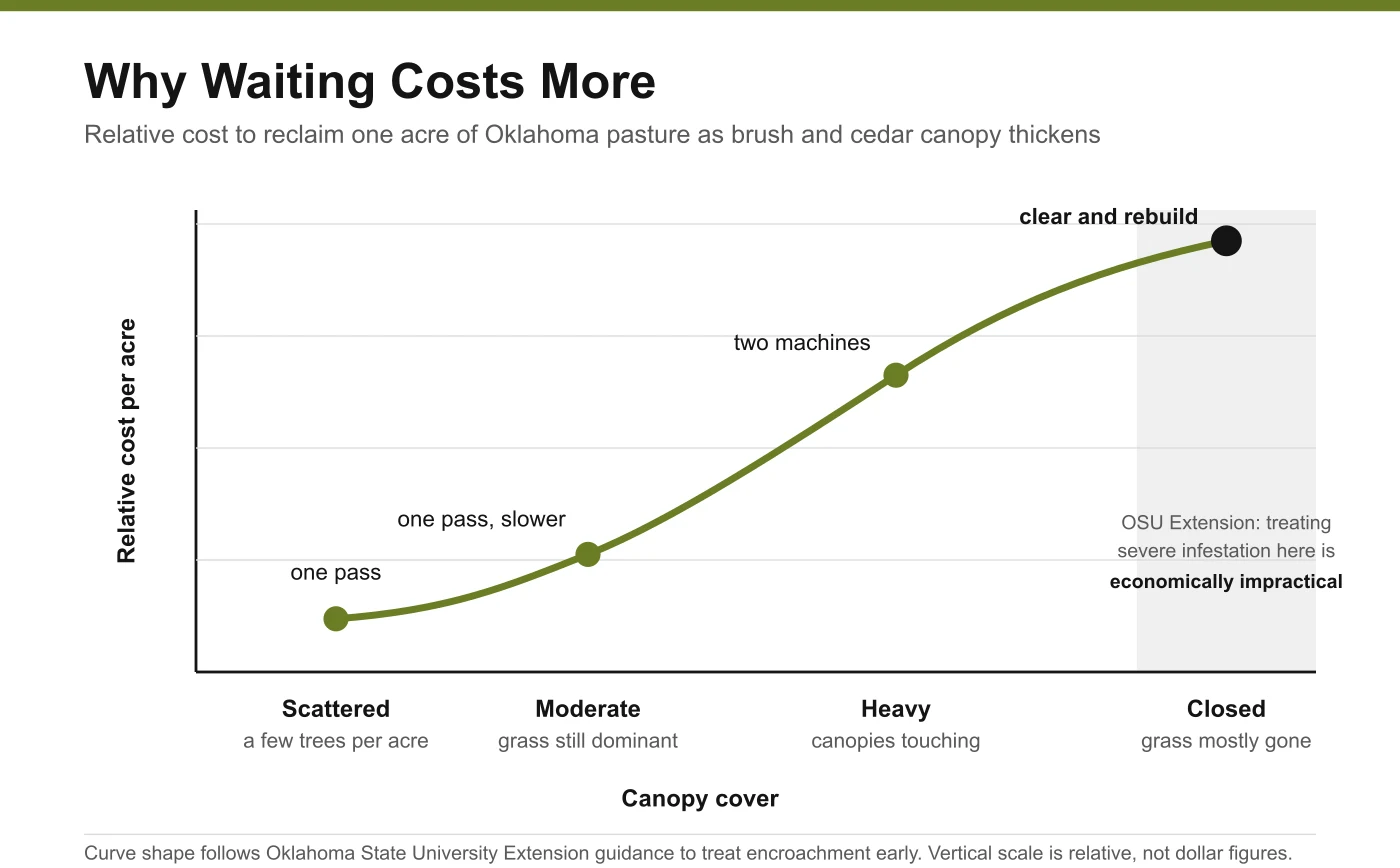
That curve is the entire argument for handling encroachment while it still looks like it can wait. The cheapest acre you will ever clear is the one that is only lightly grown up. The least useful money you can spend is on a pasture that has already gone to closed canopy and then gets left alone again afterward.
Which machine your ground actually needs
There is no single right method, and any contractor who quotes you before walking the property is quoting the machine already on his trailer rather than the job. The framework comes down to two questions: what is standing, and what has to happen on that ground afterward.
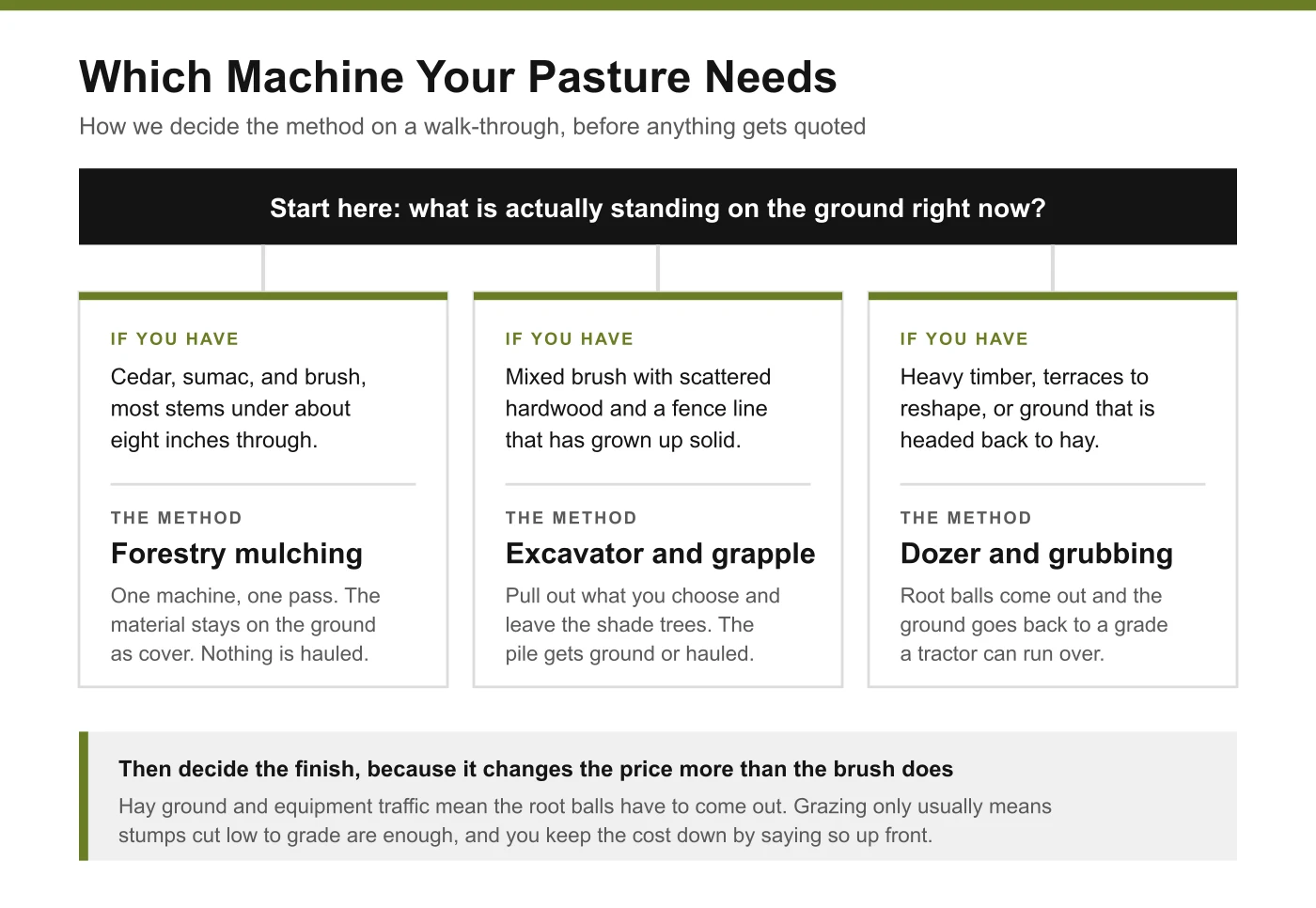
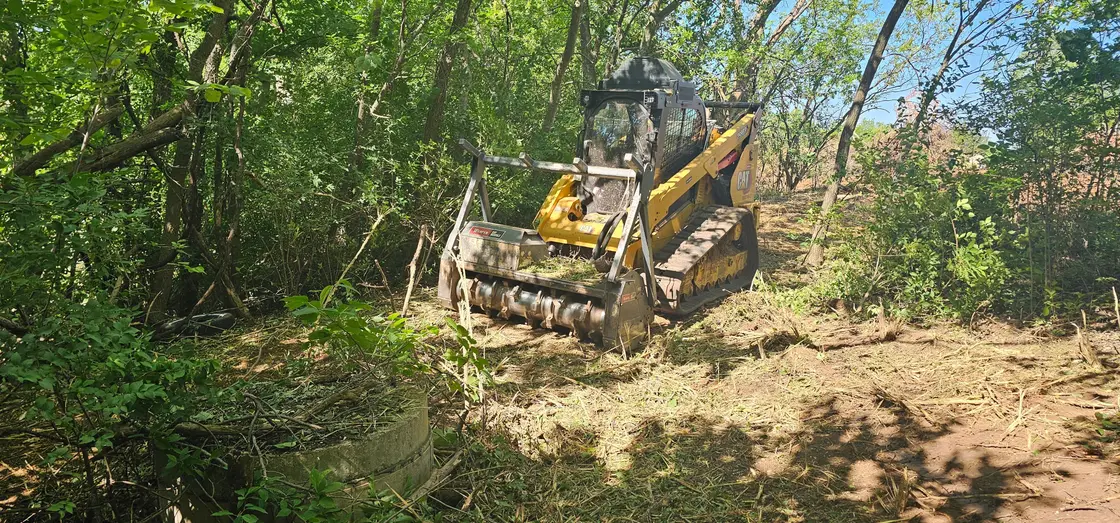
Forestry mulching is where most cedar-choked pasture lands. A carbide drum takes the standing material down where it stands and throws it to the ground as chips. Nothing gets piled, nothing gets trucked, and the chip layer holds the soil in place through the first hard rain after clearing.
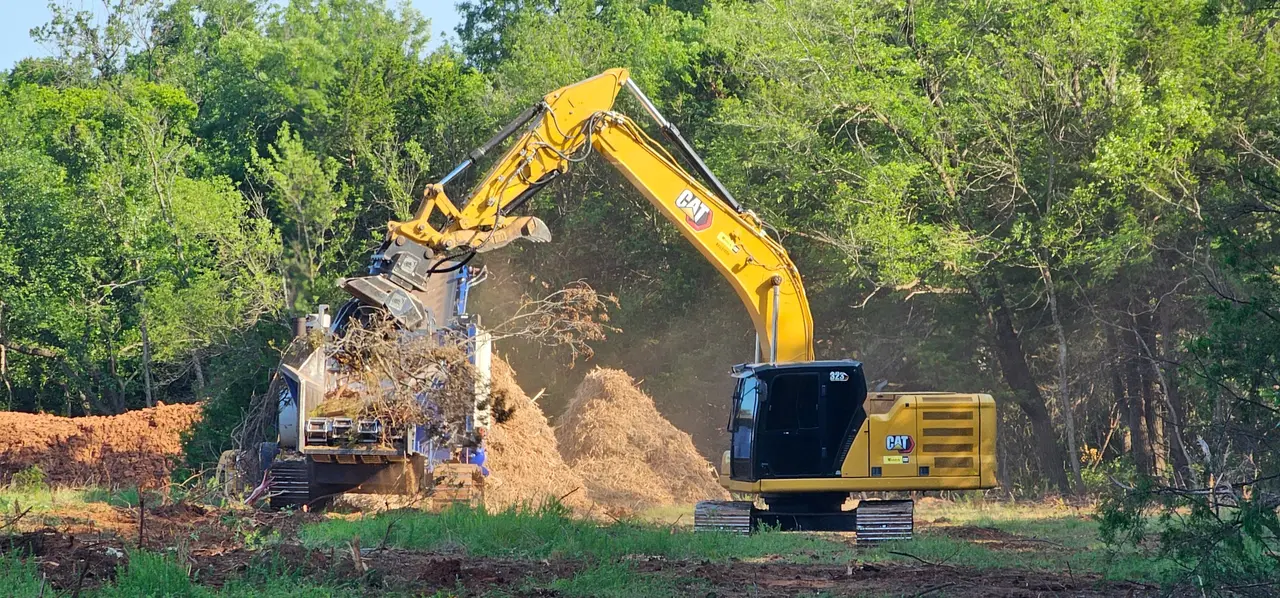
An excavator with a grapple earns its keep when the job is selective. Mature shade trees you want to keep, a grown-up fence line, scattered hardwood mixed into brush, a draw that has to be cleaned out without tearing up the banks. The operator takes what you point at and leaves the rest standing.
A dozer with grubbing is the answer when the timber is heavy, when terraces have to be reshaped, or when the pasture is headed back to hay and the ground has to be smooth enough to run a baler across without finding a root ball the hard way.
Matching method to ground
| What is standing | Usual method | What you get back | What it does not fix |
|---|---|---|---|
| Scattered cedar in open grass | Mulching, one pass | Grazeable acres, quickly | Seedlings still in the soil |
| Cedar and brush, canopies touching | Mulching, slower pass | Open pasture under a chip layer | Root balls stay in the ground |
| Mixed brush with keeper trees | Excavator and grapple | Selective clearing, shade kept | Ground is not regraded |
| Grown-up fence line or right of way | Grapple or mulcher along the line | A workable, fenceable perimeter | Existing fence may need rebuilding |
| Heavy timber, ground going to hay | Dozer plus grubbing | Smooth, implement-safe ground | Costs the most per acre |
| Draws and rough ground | Excavator work | Access and drainage restored | Not a substitute for grade work |
Do you have to reseed after clearing?
Usually not, and this is the single most common place landowners spend money they did not need to spend.
OSU Extension is direct about it: once redcedar is cut or burned, it is unnecessary to reseed the area. The native grass seed bank is still sitting in the soil under that canopy. What was suppressing it was shade and water competition, and once those are gone, it responds on its own. Give it a growing season before you decide anything.
Reseeding is worth a real conversation when the topsoil was scraped or moved during grading, when the ground was never native grass in the first place, or when you are converting to an introduced forage on purpose. Those are agronomy decisions rather than clearing decisions, and your Canadian County Extension office is the right place to take them. We do brush and dirt work, not seed, and we would rather tell you that than sell you something you do not need.
Stumps: leave them low or take them out
This is the question that moves your quote the most, and it has a simple test. Is a tractor, a sprayer, a baler, or a truck going to run across that ground?
If the answer is no, and the pasture is grazing ground, stumps cut low to grade are fine. Cattle work around them and you keep the money in your pocket.
If the answer is yes, the root balls have to come out. A stump hidden in regrown grass is a broken implement and a repair bill, and the second time it happens it costs more than the grubbing would have.
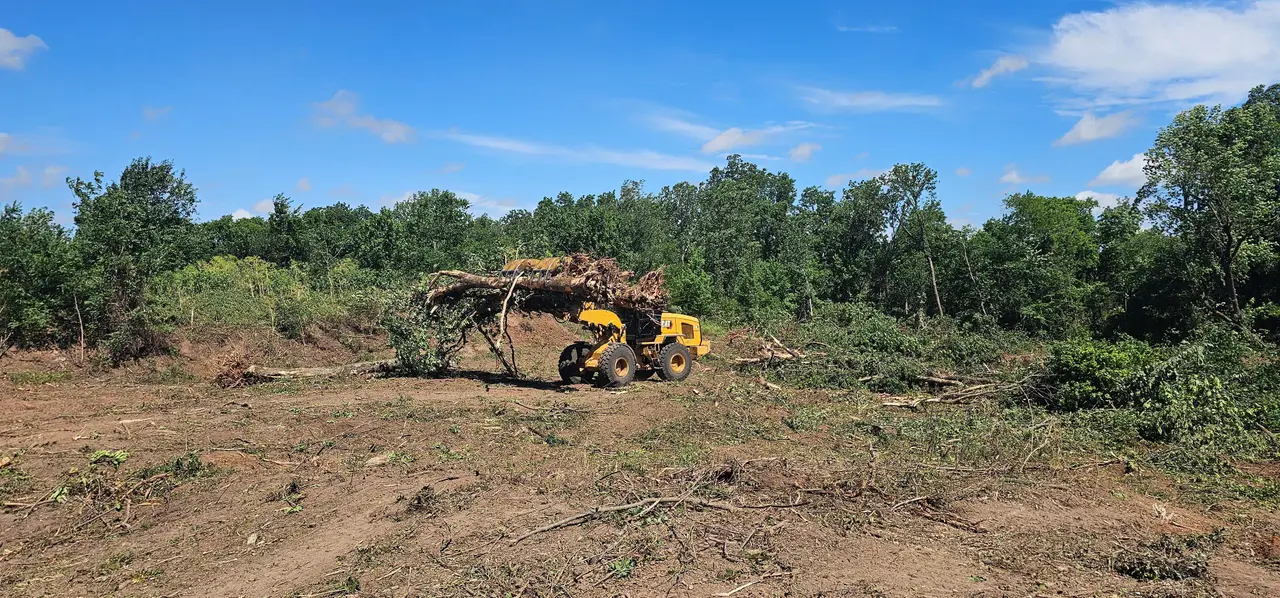
One thing worth knowing about cedar specifically: it does not resprout from the stump the way many hardwoods do. A cedar cut below its lowest green limb is finished. What comes back is new growth from seed, which is a maintenance problem rather than a re-clearing problem, and it is a much cheaper one to stay ahead of.
Before anyone starts processing stumps or moving dirt, utility locates have to be filed. That is a free call and a legal requirement in Oklahoma, and it is handled through OKIE811. Buried lines cross rural acreage more often than people expect, especially anywhere near a section line or an old well site.
The things people forget until the machine is already there
- Terraces. Old terraces hidden under brush are easy to damage and expensive to rebuild. Point them out on the walk-through.
- Water lines and tanks. Rural water lines are frequently shallower than the map suggests, and a stock tank line is rarely where anyone remembers it being.
- Property corners and fence rows. Clearing tight to an unsurveyed line is how neighbor disputes start. If a corner is uncertain, resolve it first.
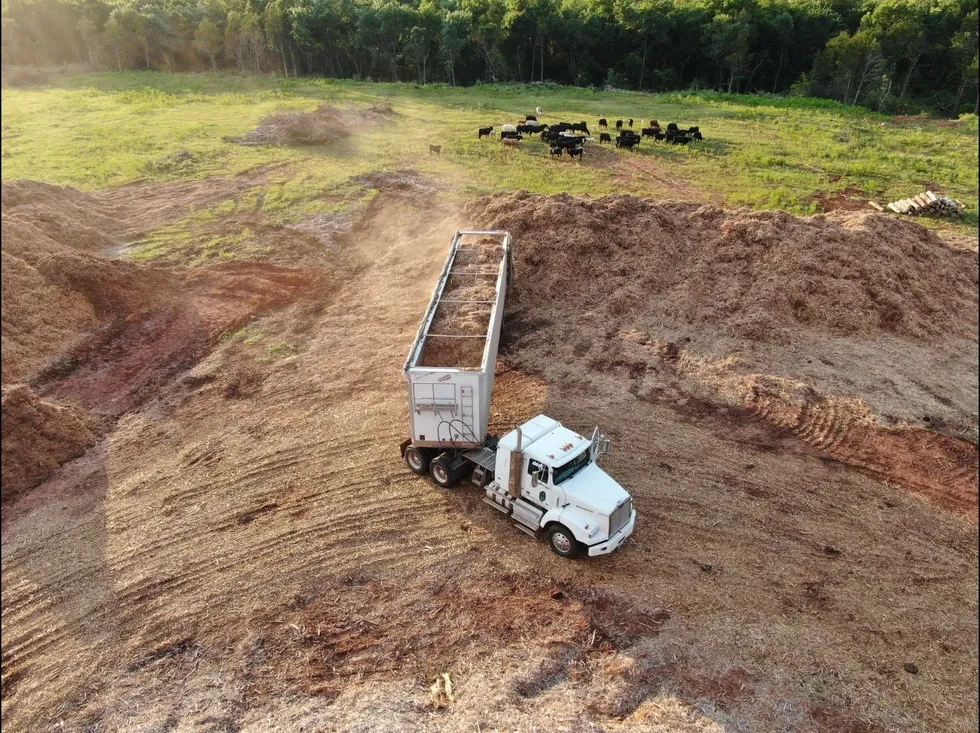
- Where the material goes. Chips can stay on the ground, but a pile has to be ground down or hauled off. Decide before the work starts, not after there is a pile.
- Prescribed fire plans. If you run one or intend to run one with your county Extension office, say so up front, because it changes whether material gets left in place or processed.
- Access. If the equipment cannot reach the back forty, the road comes first. That may mean access road work before any clearing happens.
When to do it
Late fall through early spring is the practical window for most pasture work in central Oklahoma. The ground is firmer, the brush has dropped its leaves so operators can actually see what they are working in, snakes and ticks are not a factor, and you are not tearing up ground during the growing season when the grass is trying to establish.
Cedar in particular is easiest to inventory in winter, because it stays green when everything around it is brown. If you are trying to figure out how much you actually have, drive the property in January.
Brush does not read a calendar, though. Dry summer ground is workable too, and if a pasture is far enough gone that it is cutting into your carrying capacity, waiting eight months to start is its own cost.
What to ask before you hire anyone
- Will the person quoting this job be the one running the equipment on it? In-house crews and brokered work are not the same product.
- What machine are you bringing, and why that one for this ground?
- Is the material staying on the property or leaving?
- Are stumps cut to grade or coming out, and which am I being quoted for?
- Have locates been filed?
- What does the ground look like the week after you finish, not the day after?
If a contractor will not walk the property before quoting, that is your answer.
Pasture work in Mustang and Canadian County
The acreage along the SH-152 corridor west of Mustang is a pattern we see constantly: land that was grazed for decades, then held without active management, with cedar working in from the fence lines and the draws. It is fixable ground. In most cases it is also good ground underneath, which is why it is worth reclaiming rather than working around.
Mustang, Yukon, El Reno, and the rest of Canadian County are all inside our regular service area, along with the OKC metro and about 150 miles out from it. If you want the wider picture on what this kind of work runs, we broke that down in what land clearing costs per acre in central Oklahoma, and the method question in more depth in forestry mulching vs. traditional land clearing. Nearby work is listed on our Yukon land clearing page, and the full list of brush clearing services covers what else goes with this kind of job.
Innovative Services is family owned and operated, and the crews are fully in house. The people who walk your pasture and put the number on paper are the same people who show up with the machines. Estimates are free and done in person, on your ground, because there is no honest way to price this from a satellite photo.
Call (405) 465-2809 or request an estimate and we will come walk it with you.