
- Roads & Ponds
- Site Preparation
Private Access Road Construction on Oklahoma Acreage
A cleared strip of dirt is not a road. Here is what holds up on central Oklahoma clay, and why the cold months are when a bad driveway shows itself.

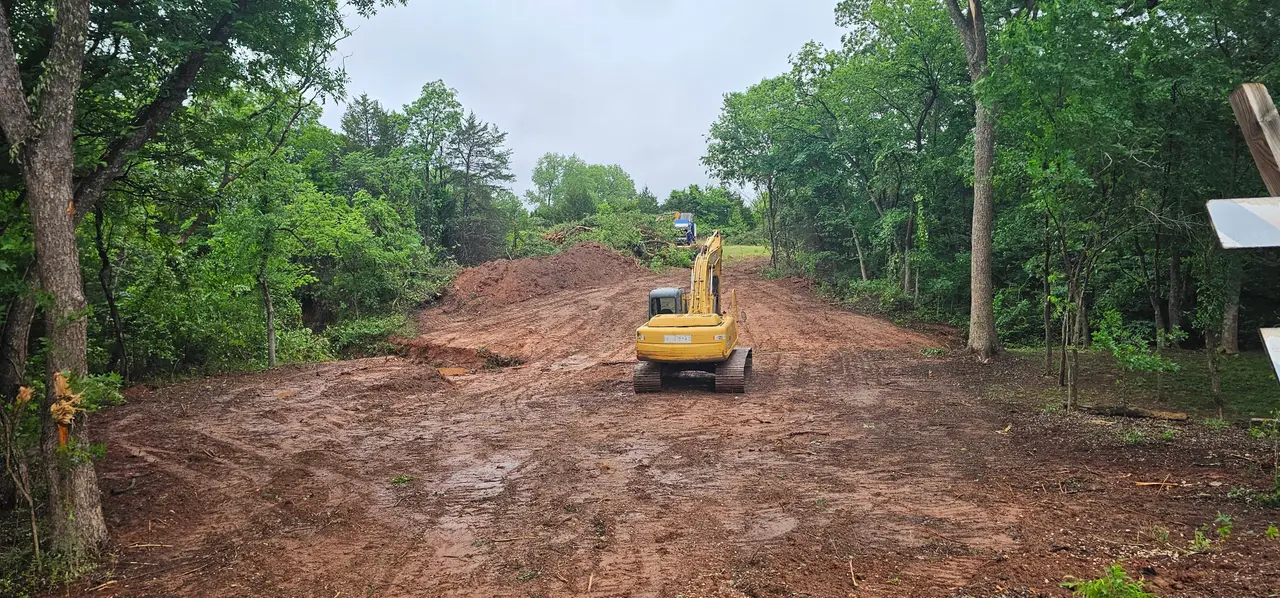
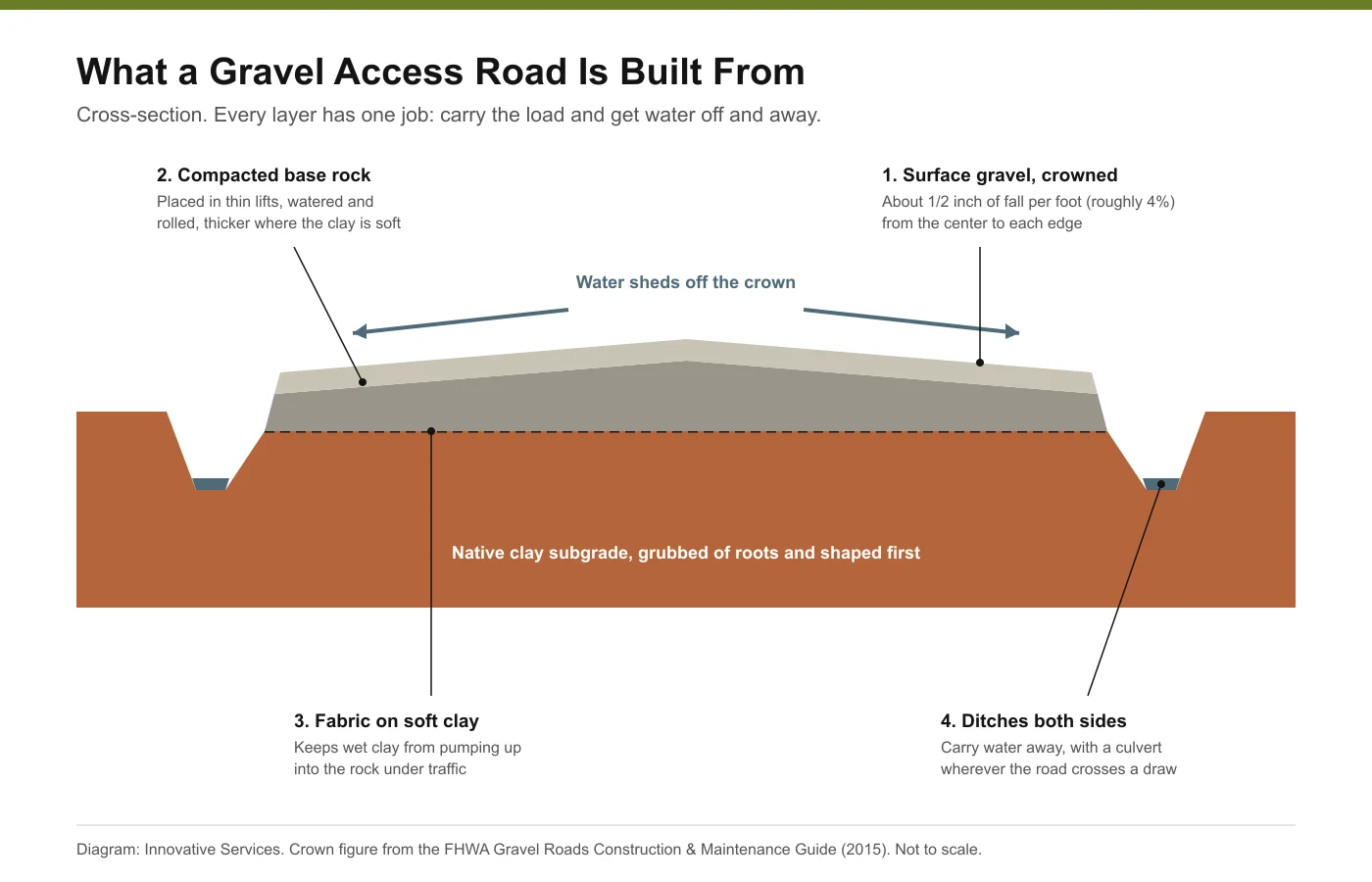
A private access road that lasts on Oklahoma acreage is built in layers: a cleared and grubbed corridor, a shaped clay subgrade, compacted base rock (with fabric over soft clay), crowned surface gravel, and ditches and culverts that carry water away. A driveway that ruts and potholes every winter almost always skipped one of those layers, and the federal guide on gravel roads names drainage as the one that is too often ignored.
Winter is when you find out. Here is how a road gets built on central Oklahoma clay, how to read what your driveway is doing this month, and what can and cannot be done in the cold.
What goes into building a private access road?
Every layer of a gravel road has one of two jobs: carry the weight, or get water off and away. Leave one out and the layers above it pay for it.
- Clear and grub the corridor. Trees, brush and every root come out of the roadbed. A root left under the road rots, and a rotted root is a soft spot waiting for a loaded truck. On wooded acreage this is a land clearing and grubbing job before it is a road job.
- Shape and compact the subgrade. The native clay gets cut, filled and shaped so the road already has its fall before any rock goes down. The federal gravel roads guide from the Federal Highway Administration recommends placing material in layers of no more than about 4 inches loose (up to 8 with larger compaction equipment), watered to the right moisture, and it names sheepsfoot or pad drum rollers as the right tool on clay.
- Lay the base rock. This is the layer that carries the load. It goes down in compacted lifts, and it gets thicker where the clay is soft or where heavy trucks will run.
- Put fabric down where the clay is soft. More on that below.
- Top it with surface gravel and a crown. Surface gravel is a different material from base rock. The FHWA guide explains that good surface gravel needs some clay in it to bind into a tight driving surface, while base rock needs very little, and one material rarely does both jobs well.
- Cut the ditches and set the culverts. Ditches on both sides, and a culvert anywhere the road crosses a draw. Build a road across a natural drainage without a pipe and you have built a dam.
Why does a gravel driveway fall apart every winter in Oklahoma?
Because an Oklahoma winter is not one long freeze. It is dozens of short ones.
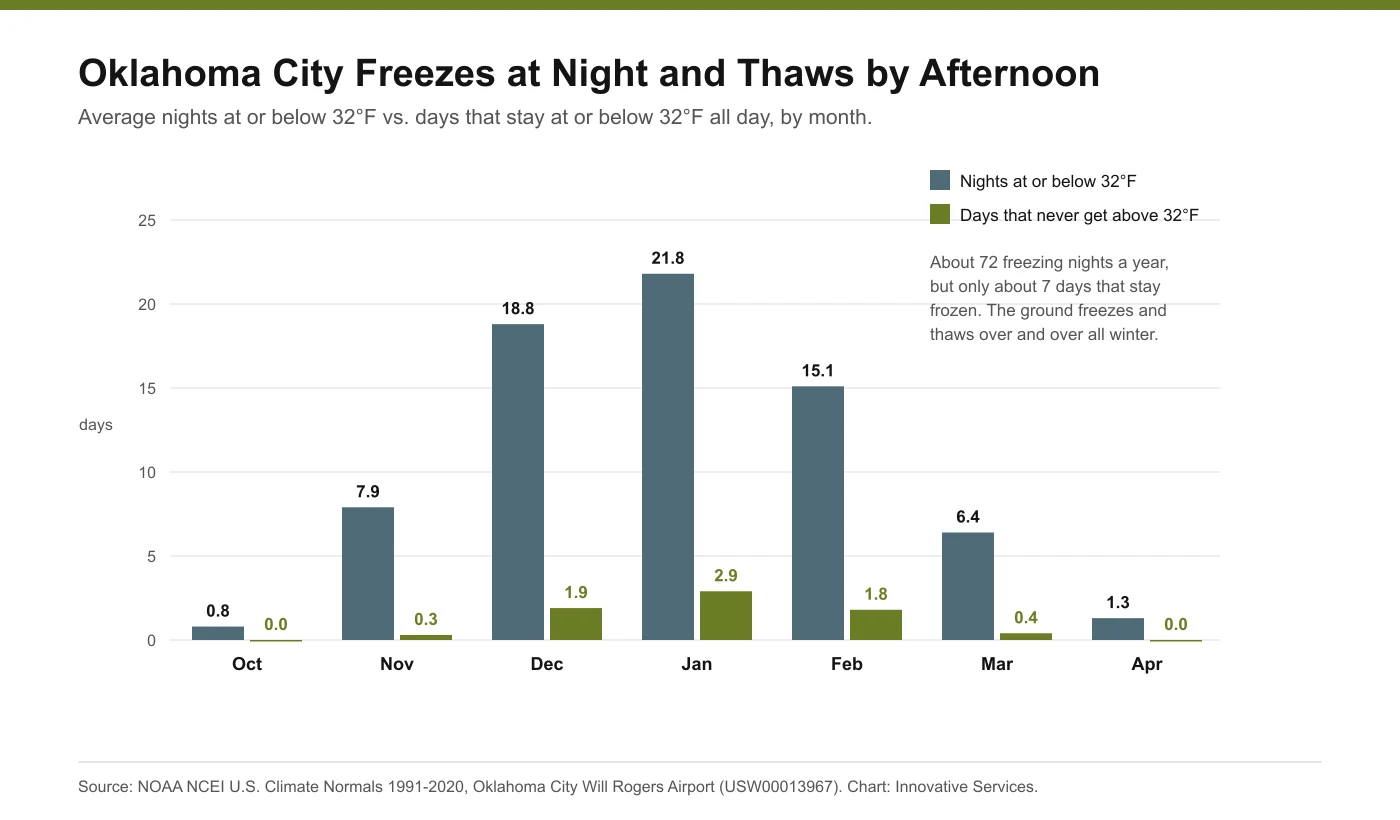
NOAA’s 1991-2020 climate normals for Oklahoma City (Will Rogers Airport) count about 72 nights a year at or below 32°F, but only about 7 days a year when the temperature never climbs above freezing. January alone averages almost 22 freezing nights and fewer than 3 frozen days. So the top of your driveway freezes at night and thaws by afternoon, over and over, from late November into March.
Freeze and thaw only hurts a road that is holding water. Water that sits in a flat spot or soaks into a thin base freezes, loosens the gravel around it, thaws into mud, and gets pushed out by the next tire. Then it does it again the next night. A road that sheds its water goes through the same cold and comes out fine.
That is why the FHWA guide opens its drainage section with an old line from the road business: the three most important things in building and maintaining roads are “drainage, drainage, and drainage.”
What is your driveway telling you this winter?
Walk your road after the next rain or the next hard freeze. What it shows you points straight at what was skipped when it was built.
| What you see | What it usually means | What fixes it |
|---|---|---|
| Potholes down the middle of the road | The surface is flat or rounded on top, so water sits in the center instead of running off | Reshape to a straight crown, about 1/2 inch of fall per foot to each edge |
| Everyone drives the center, the edges washboard | The crown is too steep, and drivers avoid the sloped edges | Pull it back toward about 4 percent; the FHWA guide says not to exceed 6 |
| Ruts in the tire tracks that hold water | The base is too thin for the trucks using it, or the subgrade under it is soft | Rebuild the base in compacted lifts, thicker where it failed |
| Mud squeezing up through the rock | Wet clay is pumping up into the base under traffic | Dig out the soft spot, lay fabric, rebuild with at least 6 inches of rock over it |
| Gullies running down the road after a rain | There are no working ditches, so the road is the drainage channel | Cut ditches and turn the water off the road before it gains speed |
| One spot that never dries out | The road crosses a draw or a wet weather seep with no culvert, or the culvert is crushed or silted shut | Set or replace the culvert, or rebuild the crossing |
Adding a load of gravel to a pothole does not fix any of these. It fills the hole until the water that made it comes back. Fix the shape and the drainage and the potholes mostly stop on their own.
How much crown does a gravel road need?
About 1/2 inch of fall per foot of road width from the center to each edge, roughly 4 percent. That is the figure the FHWA guide reports from road supervisors and operators across the country, and it warns against going over 6 percent in any condition.
Shape matters as much as the number. The road should look like the roof of a house, a straight line from the edge up to the center. When the top gets rounded over (the guide calls it a parabolic crown), the middle of the road is nearly flat and that is exactly where the potholes start.
Width is set by the biggest truck that will use the road, not the car you drive every day. If a concrete truck, a propane delivery, a semi hauling equipment or a fire truck has to reach the house or the barn, the road, the turns and the turnaround have to be built for that truck. We plan that on the walk-through, before the first tree comes down.
Do you need fabric under a gravel road on clay?
On soft central Oklahoma clay, often yes. Here is what it does.
When a loaded truck rolls over a road, the road flexes a little. On wet clay, that pressure pushes water up out of the subgrade and carries fine clay with it into the rock above. The FHWA guide calls this pumping, and it turns good base rock into a weak, muddy mix that will not drain. Fabric laid on the subgrade keeps the clay and the rock apart while still letting water through. The guide recommends at least 6 inches of material in the first layer over the fabric, and it notes that equipment should not drive on bare fabric.
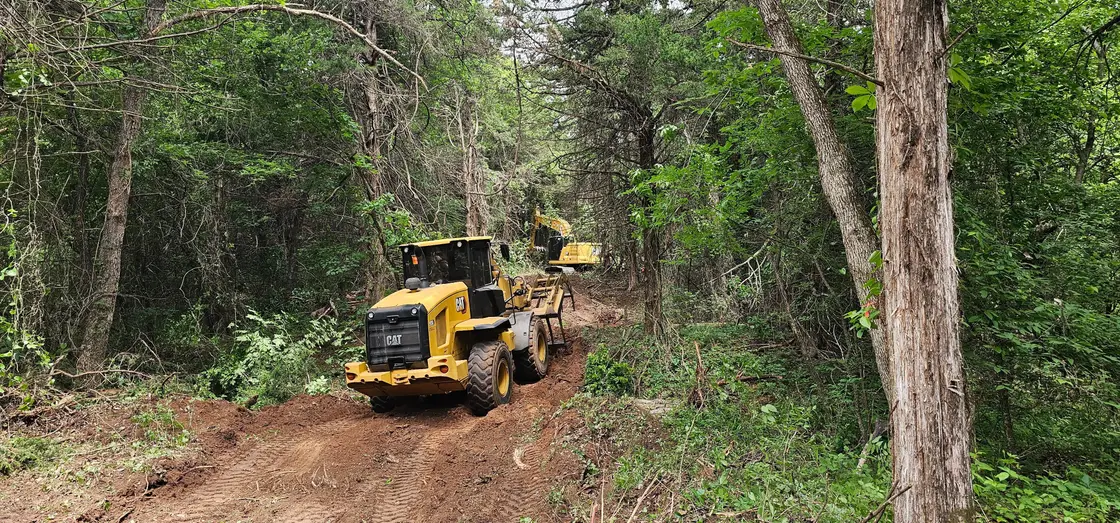
The honest trade-off: fabric is not free, and not every road needs it. On firm ground that drains well, a properly compacted base does the job. Where it earns its cost is the soft stretch at the bottom of a slope, the crossing near a pond, and anywhere a heavy truck will run on wet clay. Those are the spots we mark on the walk-through.
Can you build a road in the winter?
Yes, and in Oklahoma the cold months are often better for it than spring. By NOAA’s normals, November through February are the driest months of the year in Oklahoma City, each averaging under 2 inches of precipitation, while May averages over 5. Red clay that would be soup in May can be firm enough in December to carry equipment and take compaction.
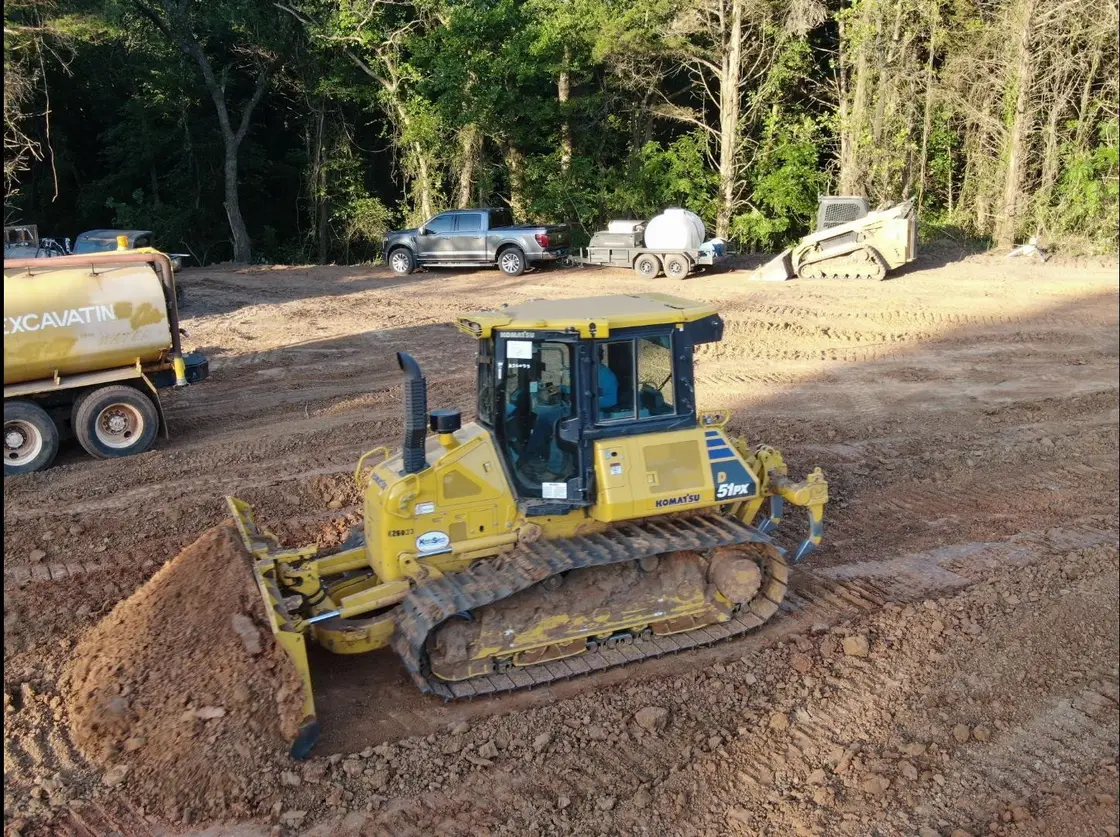
What changes is the day-to-day. We do not lay or compact rock on ground that is frozen or saturated. Compaction works when the dirt is near the right moisture (that is why the water truck in the photo is on site), and frozen or soaked clay is nowhere near it. Material compacted frozen settles when it thaws. So a winter road job runs on the weather: clearing and grubbing on cold mornings, shaping and base work on the days the ground is right, and nothing rushed onto a frozen subgrade to hit a date.
The other reason winter works: if you are building in the spring, the road has to be there first. Concrete trucks, lumber deliveries and every trade after them need a way in. Our post on clearing land to build a house covers why the driveway is a first-week problem, not a last-week one.
What happens where your road meets the county road?
This is the part to sort out before any dirt moves. The ditch along the county road usually needs a culvert under your approach, and the road on the other side belongs to someone else: the county, the city or the township. Call whoever maintains that road and ask what they require for a new approach on your parcel before you build it.
Digging ditches and setting culverts also means digging near buried lines. Call or file with OKIE811 before any excavation so the utilities get marked first.
Clearing the corridor comes first
On wooded acreage, the road starts as a clearing job. The corridor has to be opened wide enough for the road, the ditches and room to work, and every stump in the roadbed has to be pulled, not cut flush. Brush and tops get ground on site rather than burned.
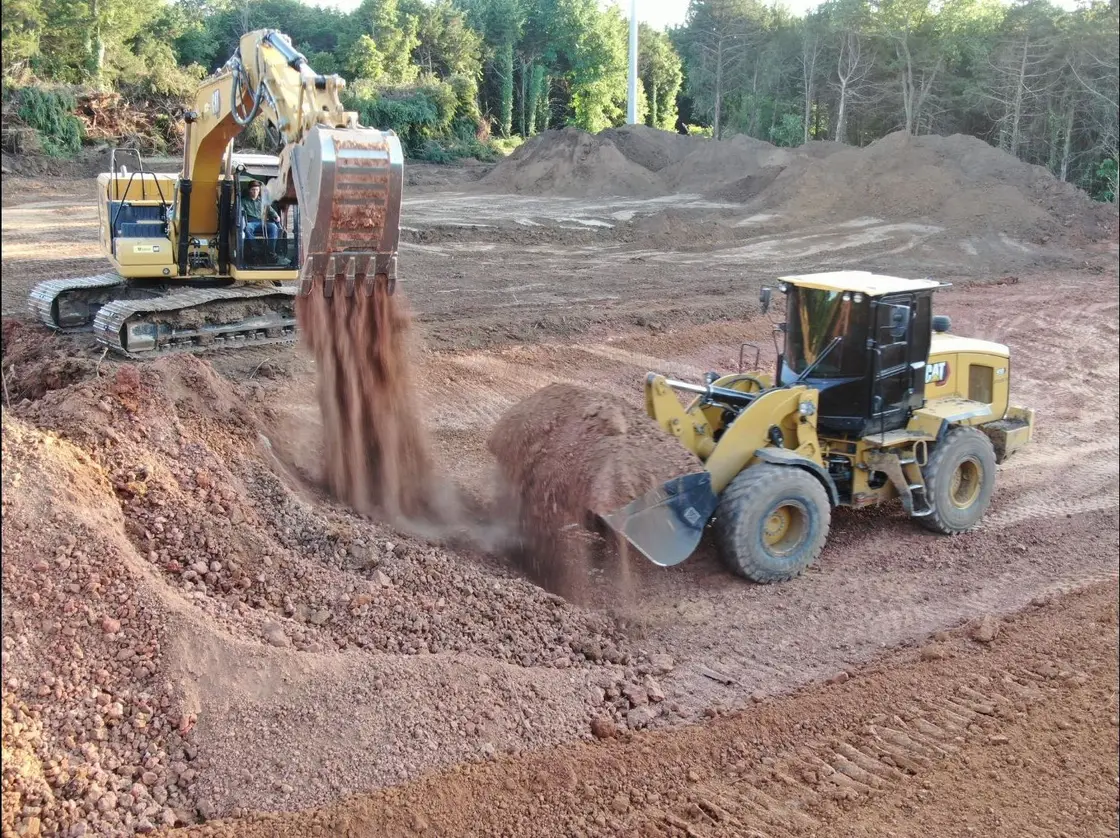
Because we clear, grub, cut the dirt and build the road with our own crews and our own machines, the road does not get handed from a clearing crew to a dirt crew to a gravel hauler with nobody owning the result. If you are also putting in a pond, the two jobs often go together; see building farm ponds and access roads.
What does a private access road cost?
We do not quote roads over the phone, because two roads the same length can be very different jobs. What moves the number:
- Length and width, set by the trucks the road has to carry.
- The corridor: open pasture or dense timber that has to be cleared and grubbed first.
- The ground: firm, well-drained soil versus soft clay that needs deeper base and fabric.
- Crossings: how many draws need culverts, and how big.
- Rock: how much base and surface gravel, and how far it has to be hauled.
- An existing road: reworking a failed driveway can be less work than a new one if the base under it is still sound.
We walk the route with you, mark the soft spots and the crossings, and give you a firm number on site for free.
Access roads across Edmond and the OKC metro
We build and rework access roads and driveways on acreage across Edmond, Oklahoma County and the rest of the OKC metro, and about 150 miles around it. If your driveway is rutting, holding water or pumping mud this winter, call (405) 465-2809 and tell us what it is doing. We will come look at it, tell you straight whether it needs a rebuild or just a reshape and some ditch work, and give you a firm number. You can also request a free on-site estimate.
Sources: FHWA, Gravel Roads Construction & Maintenance Guide (August 2015). NOAA NCEI, U.S. Climate Normals 1991-2020, Oklahoma City Will Rogers Airport.