
- Timber Clearing
- Site Preparation
Clearing Wooded Acreage for a Custom Home in Oklahoma
Most trees saved on a homesite are not lost to the clearing. They are lost to the year of building that follows. Here is how to clear the land so the trees you keep are still alive when you move in.

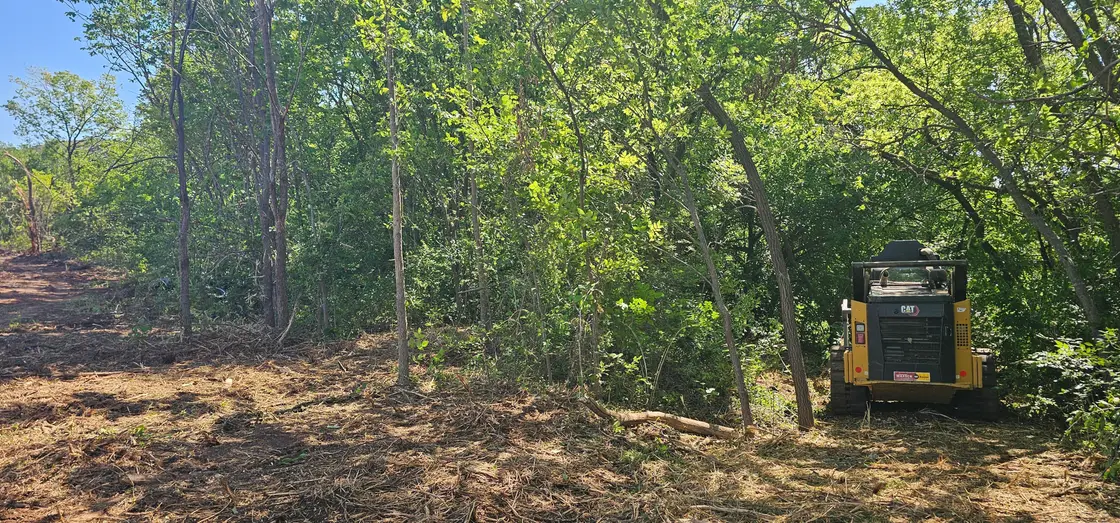
Clearing wooded acreage for a custom home starts with deciding what stays. Before a machine touches the ground, stake the house footprint, the driveway, the utility routes and a working ring around the house, then mark the trees you want to keep and fence off their root zones. Everything inside the stakes comes out, stumps and all, so the pad and driveway sit on clean ground. Everything inside the fences gets left alone, by us and by every truck and crew that comes after us.
That second part is where most homesites go wrong. The clearing takes days. The build takes most of a year, and that is when the trees people paid to save get hurt. Here is how we clear a wooded homesite so the oaks you keep are still alive when you move in.
Start with the trees, not the house pad
The walk-through decides the whole job. We walk the property with you and your plans, and we stake four things before we talk about a single tree:
- The house footprint, plus room for the foundation crew to work around it.
- The driveway, wide enough for concrete trucks and lumber deliveries, not just your car.
- The utility routes: power, water and anything else that has to be trenched from the road or the meter to the house.
- A working ring around the house where equipment, materials and dirt will move during the build.
Then we look at the trees. A tree worth keeping is healthy, sound at the base, not leaning toward the house, and far enough from all four of those areas that its roots will not be in the way. A big post oak 12 feet from the corner of the house is not a keeper, no matter how good it looks today. More on that below.
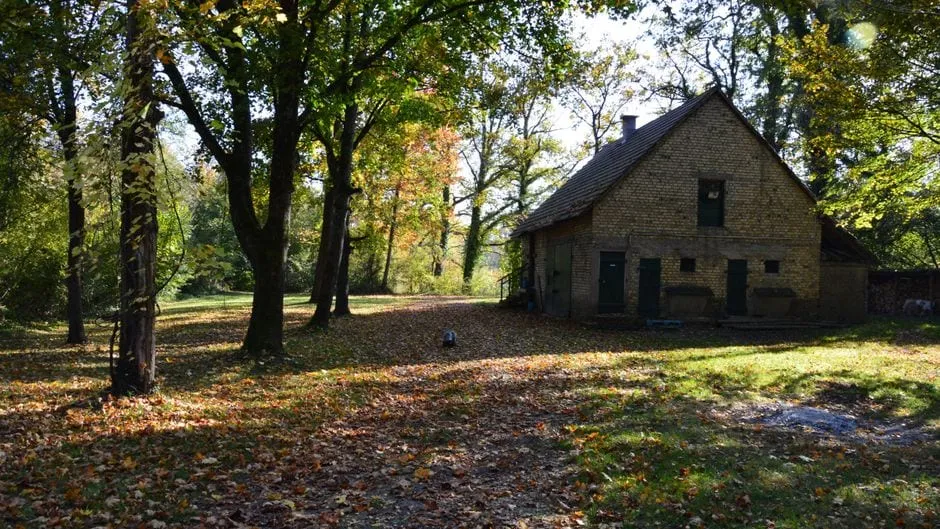
Winter helps here. With the leaves off, you can see each tree’s crown, the dead limbs at the top and which way it really leans. It is the easiest time of year to tell a healthy oak from one that is already in decline, and a site cleared in winter is ready for your builder when spring comes around.
Why trees you save die after the house is built
Here is the misconception: if a tree comes through the clearing and still looks fine when the house is done, it made it. It often did not.
Oklahoma State University Extension’s fact sheet on site disturbance and tree decline says trees that are thought to be saved often go into decline and die, usually one to five years after the construction. It also names oaks as the native trees most often affected in Oklahoma. On the post oak and blackjack ground east of Oklahoma City, that is most of the trees worth keeping.
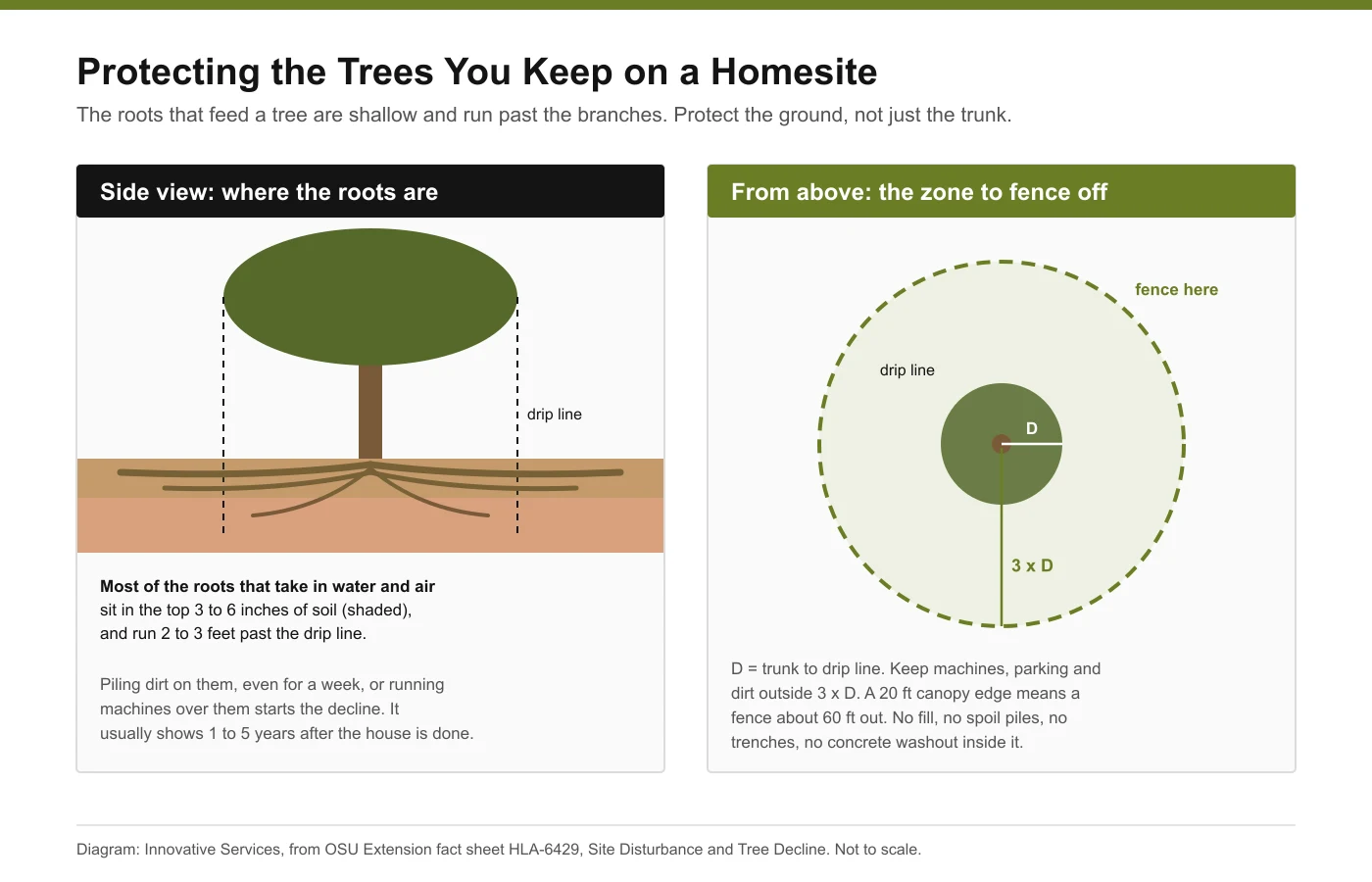
The reason is where the roots are. According to the same OSU fact sheet:
- Most of the roots that take in water and air sit in the top 3 to 6 inches of soil and reach 2 to 3 feet past the drip line, the edge of the branches.
- Soil should never be piled over them, even for a short time. Fill smothers those roots, and clay fill does more harm than sand or gravel.
- Oaks are very sensitive to even low levels of compaction. Parking trucks and equipment in the shade of an oak is exactly the kind of traffic that does it.
- Cutting roots on one side of a tree can kill that half of the tree.
- Even taking out the neighboring trees and suddenly exposing a keeper to full sun has been seen to set off decline.
By the time the top of the tree starts thinning, the damage underground happened years ago, and OSU notes that once the decline shows, it is usually impossible to reverse.
How far to keep the machines away
OSU’s number is simple to use: keep vehicles and heavy equipment outside a boundary three times the distance from the trunk to the drip line. If an oak’s branches reach 20 feet out, the fence goes about 60 feet from the trunk.
That is a lot of ground on a wooded homesite, and it is exactly why the house, driveway and utilities have to be laid out first. You usually cannot give that much room to every tree, so you pick the ones worth it and give them all of it.
Inside the fence, for the whole build:
- No parking, and no turning trucks around.
- No fill, no topsoil piles and no spoil from the foundation dig, not even “just for a week.”
- No trenches. Route the utility lines around the zone, or have the trench bored under the roots. OSU’s fact sheet recommends tunneling under roots larger than about an inch and a half instead of cutting through them.
- No concrete washout, no stacked lumber and no burn pile.
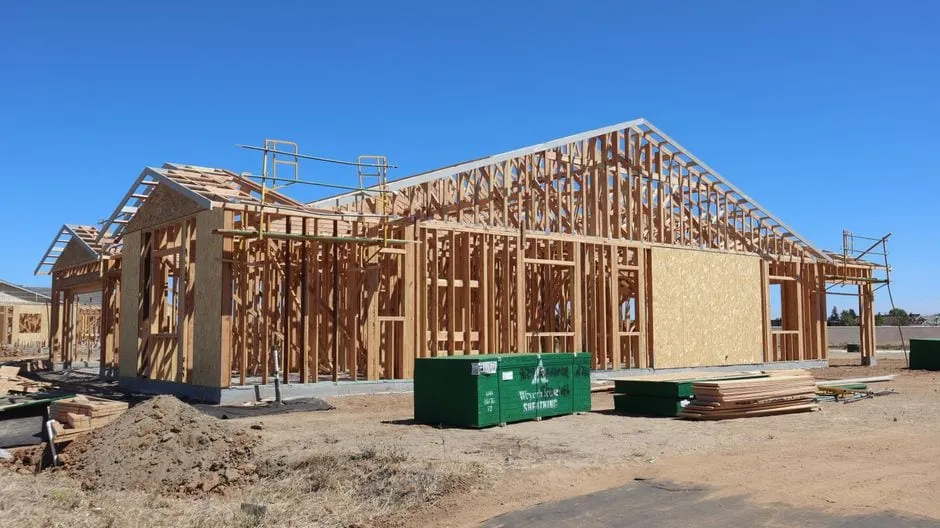
The fence goes up before any machine arrives and stays up until the landscaping is done. Stakes and tape get driven over. A real fence gets noticed by the concrete driver, the framers and the electrician, and those are the people your trees need protecting from long after we leave. Before any trench goes in, call OKIE811 so the existing lines are located.
Clearing around the trees you keep
The machine matters most at the edge of a protection zone. Here is how we match the equipment to the ground:
| Equipment | Where it fits on a wooded homesite | What to watch |
|---|---|---|
| Forestry mulcher | Cedar, brush and small trees in the open areas and the working ring | Leaves a chip layer on the ground; keep it out of the fenced zones |
| Excavator with a grapple | Taking trees down next to a zone from outside it, reaching in instead of driving in | Slower, but the tracks stay off the roots |
| Dozer | Clearing and grubbing the house pad and driveway | Pushes soil and roots ahead of it, so it stays well clear of every fence |
Inside the house pad and driveway, every stump and root comes out. A root left under a slab rots and leaves a soft spot, which is why grubbing is part of every pad we prep. At the edge of a protection zone, we stop grubbing. A stump just inside the fence line gets cut flush or ground down instead of pulled, because pulling it tears up the keeper’s roots along with it. We covered when each one makes sense in stump grinding vs. root grubbing.
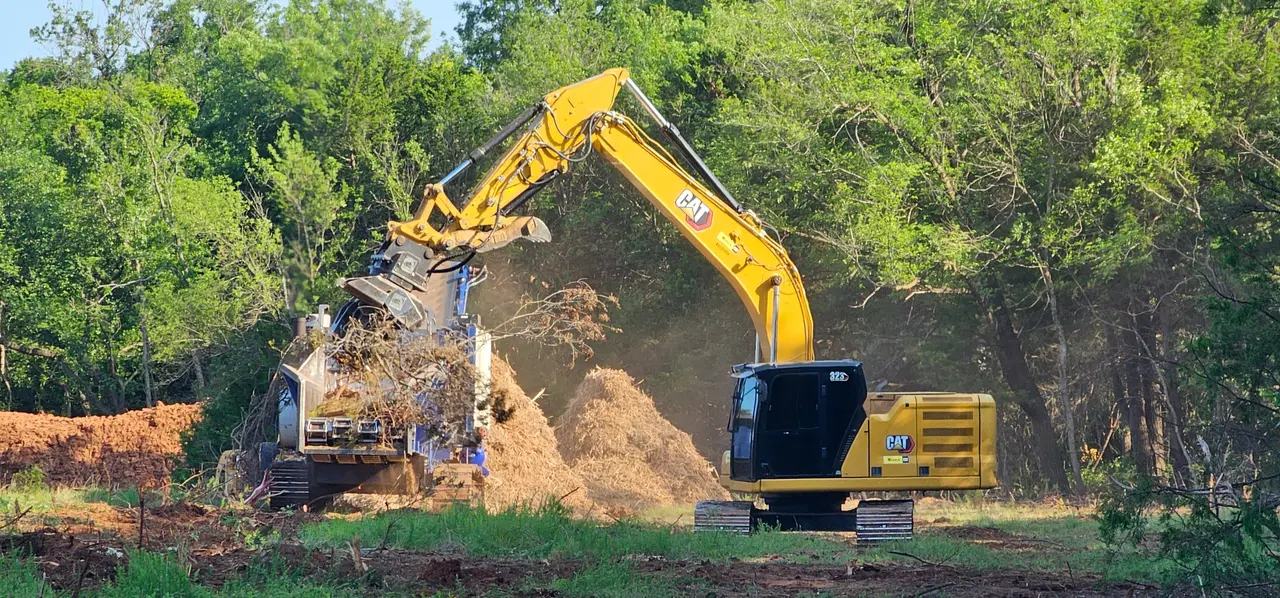
The same goes for the cedar under the oaks. Cedar growing in the understory of a post oak stand competes with the oaks for water, and close to a house it is a fire problem. Inside the zones, cut the cedar by hand and lift it out from outside the fence instead of running a mulcher over the roots. If fire is part of your plan for the site, our guide to clearing cedar around your home before fire season covers how much room to give the house.
When taking a tree out now is the better call
Saving every tree is not always the right answer, and we will tell you so on the walk-through. Take a tree out during the clearing if:
- The foundation, the driveway or the pad cut will run through its root zone. If the house sits 10 feet from the trunk, the roots on that side are going to be cut. You are betting on a tree that has already lost the bet.
- The grade has to change around it. Lowering the grade cuts the roots, and raising it smothers them. OSU names grade changes, along with compaction, as the major kinds of site disturbance.
- The utilities cannot be routed around it and boring under it is not an option.
- It is already in decline. Dead limbs in the top of the crown, early fall color or a hollow base mean the tree is not worth building around.
Here is the trade-off in plain terms. Taking a big oak down while the site is open is a normal clearing job: the machines are already there and nothing is in the way. Taking the same tree down three years later, after it has died 15 feet from your new roof, is a harder and slower job with a finished house and lawn in the way. If a tree is a coin flip, it is usually cheaper to make the call now.
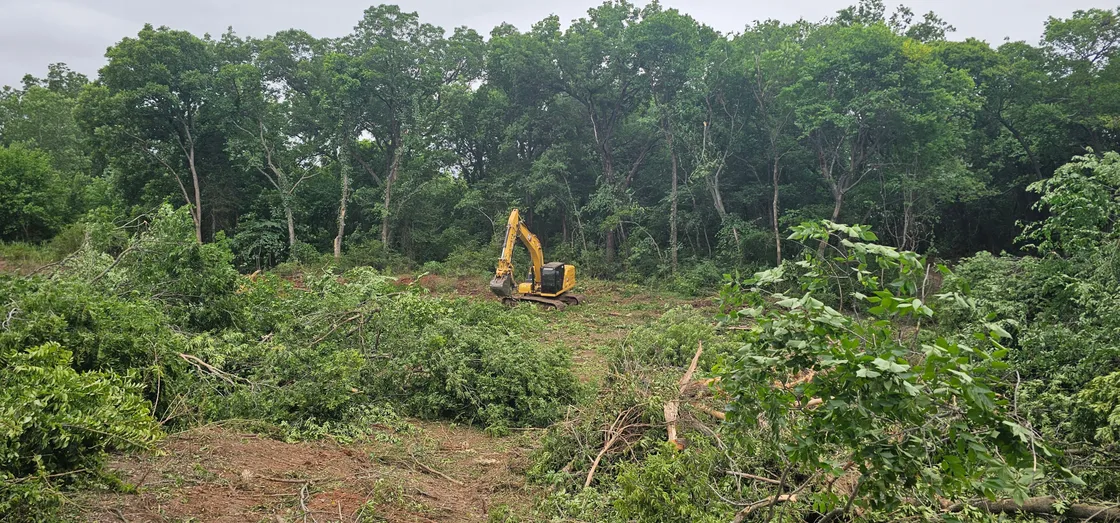
The reverse is also true. A healthy oak with plenty of room around it is worth every foot of fence. A mature tree is the one thing on a new homesite you cannot buy back, and our guide to selective tree clearing covers how we pick the keepers on a larger tract.
Wooded homesites east of Oklahoma City
Around Choctaw, Harrah, Jones and the rest of eastern Oklahoma County, a lot of the land being built on is post oak and blackjack woods with a thick layer of cedar and brush underneath. Those oaks grow slowly, so a big one is decades old, and they do not bounce back from a construction site. The cedar comes out easily. The oaks need the planning above.
We clear and prep homesites on that kind of ground across the OKC metro, with our own operators on our own timber clearing and grading equipment, never subcontracted. The crew that walks the site and stakes the zones with you is the crew that runs the machines on it, so the plan you agree to is the plan that gets built. When the clearing is done, we can cut in the driveway too. Our guide to private access road construction covers what goes under it.
The estimate is free and done on your land. Call (405) 465-2809 or request a free estimate, and we will walk the site with your plans and tell you which trees we would build around and which ones we would not.